

Papyrus
Gallery Location
Not on View
Medium
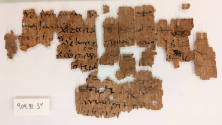
papyrus; in 12 fragments
Geography
Excavated at Theadelpheia (Batn al-Harit), Egypt
Date
around 100-300 CE
Period
Roman Imperial period
Dimensions
16.2 x 8.4 cm
Object number
909.81.3
Collection
Department
Art & Culture: Ancient Greece & Rome
Object History
The papyrus was excavated near the modern town of Batn al-Harit (ancient Theadelpheia) in the Fayum, Egypt, indicated by the Greek letter theta (θ) inscribed on the front (recto) and back (verso) of the manuscript. Led by Bernard P. Grenfell and Arthur S. Hunt and sponsored by the Egypt Exploration Fund (EEF), the excavation occurred between January and March of 1899. At the close of the dig, all artifacts, including this papyrus, were delivered to Oxford University. The papyrus was acquired by the ROM from the EEF in 1909, likely as a result of subscriptions to the EEF collected by Toronto donors and overseen by C. T. Currelly. Between 14 September 1967 and 20 February 1976, the papyrus was in the care of Alan Samuel, a Professor at the Department of Classics, University of Toronto, who mounted it between glass before returning it to the ROM.
Description
This papyrus is an administrative roll with writing in Greek on both sides, in black ink and a documentary hand, now in 12 small fragments.
The front (recto) of the roll contains portions of two columns of text written along the papyrus fibres, with the numeral ια (11) in the margin between columns. Some of the text was crossed out.
The papyrus roll was reused, so there is more writing on the back (verso) aross the fibres, in a different and larger documentary hand. It is not clear what kind of document was inscribed on either side.
A processing number θ69 was written on the front (recto) and back (verso) some time after excavation.


If you see an error or have additional information, please contact us.