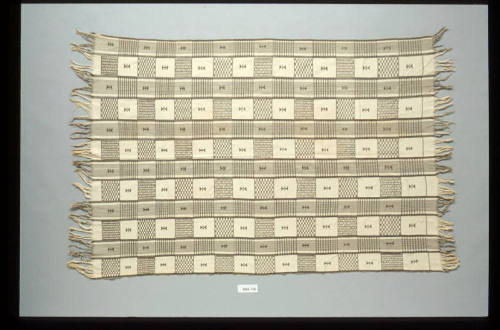
Akwete (wrapper)
Akwete cloth was historically handwoven by women in Igboland in south-eastern Nigeria. Different from the narrow strips of cloth used to make aṣọ-òkè , Akwete cloth is typically woven in a single width on a vertical loom using broadloom techniques with a warp width of about 3 - 5 feet on average. Akwete was previously termed Akwa-Miri(cloth of the water) because it was originally made for use as a towel but women began to wear them as waist wrappers in pairs long before they rose to prominence as the fashion and trade commodity of Akwete town. It changed over time in texture and richness with intricate symbolic patterns including tortoises, lizards, geometric and floral motifs making it highly prized for both everyday wear and special occasions.
This dark grey blanket displays alternating vertical panels with a combination of plain and striped patterns. Each panel is divided into square compartments that feature linear patterns, hourglass motifs, and fringe details. The design is influenced by Nnadede cloth, renowned for its unique checks created from stripes and bands, with inlay motifs arranged in a regular pattern within these checks. Named after a warrior who was presented with a similar cloth after a victorious battle, Nnadede cloth was traditionally worn by warriors and chiefs. Today, its design is appreciated primarily for its aesthetic qualities rather than its former social importance. This panel was donated by Mr G.K.J. Amarachree.