

Gelede mask
Gallery Location
Not on View
Maker
Unidentified Yoruba maker
Medium
Carved and painted wood
Geography
West Africa
Date
early 20th century, collected before 1920
Dimensions
26 x 37.5 x 30.5 cm
Object number
924.9.24
Credit Line
M.A. Leblond Collection of African carvings
Collection
Department
Art & Culture: Global Africa
Description
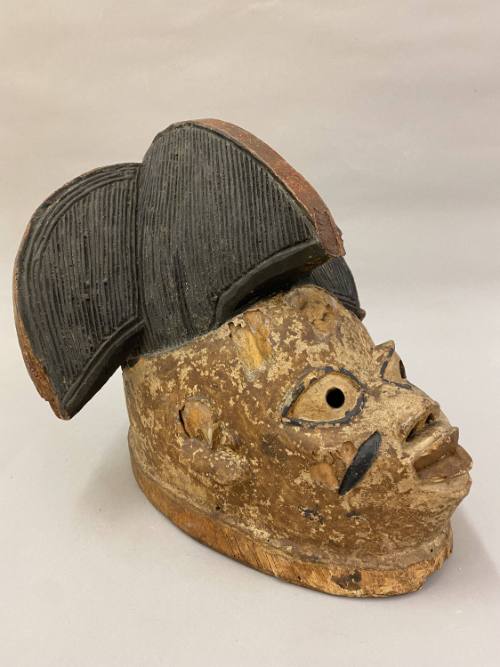
The cultural performance of Gelede is integral to the interconnectedness and well-being of the Yoruba community, as it remains a physical representation of Yoruba belief and spiritual understanding. The performance is conducted in an effort to honor and placate the 'mothers', through recognizing their spiritual power and immense influence. The term 'mothers', refers to elderly women within the community and female deities. Unique detailed masks are commissioned by individuals, most often in pairs, and are presented to the mothers alongside elaborate costume, dance, and song in an effort to elicit their good will. While night Gelede performances are reserved for the presentation of abstract extravagant masks, which make reference to the spiritual world and all its dimensions, daytime Gelede performances often exhibit naturalistic masks depicting different everyday characters, occupations, and community members. This mask features a light brown face, large widened almond-shaped eyes, closed mouth, and curved nose. The mask also has two diagonal scarification marks on each cheek. Diagonal scars are a lineage mark among the Oyo group, however they can also indicate that the person is an Abiku child - one who is destined to die before they reach maturity. When one is discovered to be an Abiku child, they adopt the diagonal scarification mark to scare away any lingering spirit companions. The top of the head features double ridged hair which protrudes both vertically and horizontally. The hairstyles featured in Gelede masks are often abstract representations of popular styles amongst the Yoruba. This particular hairstyle is closely related to another called Ojompeti, although it differs in structural design. This mask likely features a female, as such elaborate styles were mostly worn by women. During the Gelede performance, this mask would be worn atop the head of a dancer, who would wear a tunic-like garment or raffia to conceal the rest of their body.


If you see an error or have additional information, please contact us.