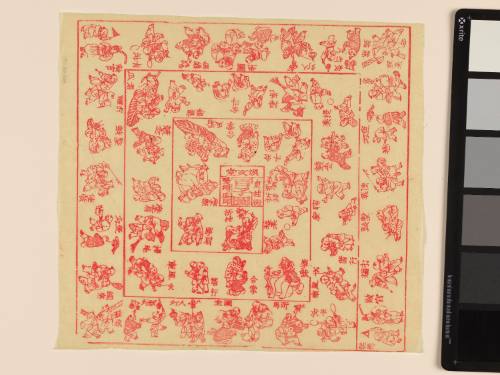
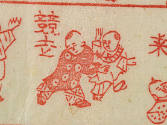
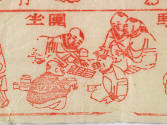
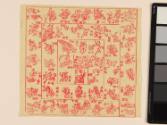
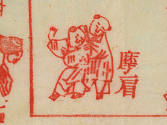
This print was used as a game board in ancient China. Printed from engraved wooden boards, this type of game board is called "Colour Selection Grid" (
caixuan ge 彩選格). It is also called " Choosing Celestials" (
xuanxian tu 選仙圖), "Promotion" (
shengguan tu 升官圖), or "Dumb Gourd" (
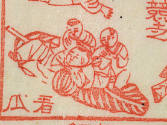
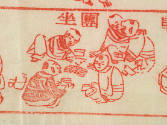
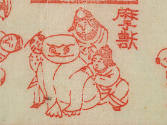
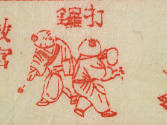
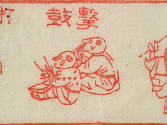
huluben 葫蘆笨). People started playing this type of game as early as the Tang dynasty. The rules of the game are very simple. Each player has a chess piece. Players take turns throwing a dice with different colours on its faces. The players move their piece forward or backward according to the colour they get. Whoever reaches the centre first wins the game. This print consists of various images of children's games. The players start their pieces from "The Start" (
qima 起馬) in the bottom right corner, then proceed upward through “Being an Official,” “Playing a Gong Instrument,” “Beating a Drum,” and so forth, all marked on the print. The game ends when a piece reaches the centre block of “Rubbing the Shoulders” and eventually “Winning the First Place.”
In ancient times, this type of game was extremely popular during New Year celebrations, and the players were not limited to children. On New Year’s Eve, people often gathered together after dinner to play the game and try their luck. The board design of "A Hundred Children Playing" comes from the story of King Wen of Zhou (Zhou Wenwang 周文王, personal name Ji Chang 姬昌). According to legend, King Wen had a hundred sons who were all wise and sensible. The theme of "A Hundred Children Playing" also reflects the wishes for “may your hall be full of sons and grandsons” and “may the family be prosperous.” Information about the name, the address of the print workshop, and the store are shown at the centre of the print, including “Donggui Street” (Donggui jie 東桂街), "Huanwen Hall" (Huanwen tang 煥文堂), and "Sealed by the Store" (fashouchu yin 發售處印).