

Pair of guardian lions
Gallery Location
Queen's Park entrance
Medium
Carved marble
Geography
China
Date
c. 1650-1750 AD
Period
Qing Dynasty
Dimensions
305 x 200.6 x 133.3 cm
Object number
923.24.218.A-B
Credit Line
The George Crofts Collection
Collection
Department
Art & Culture: China
Description
In China, from Han times onward, pairs of stone lions served to guard the entrances to Buddhist temples and tombs. Later they were also placed in front of the great palaces of the nobility to protect and defend them from evil influences. In the last century, foreigners in China misnamed these animals Fu Dogs (perhaps from the Chinese "fo" for Buddha or "fu" for palace) in spite of the fact that they are called shizi (lions) or shishi (stone lions) in Chinese. However, as lions are unknown in China, it may be that attributes of the guardian beast was based on the guardian beast of China, the dog, which augmented the later confusion.
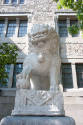
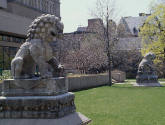
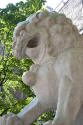
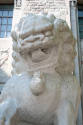
In the late nineteenth century the ROM's monumental pair of stone lions guarded the palace of Prince Su Shanqi, an imperial clansman fiercely loyal to the Manchu throne. His palace, called the Suwang Fu, was located just southeast of the Imperial City in the diplomatic quarter of Beijing. Enclosed by a high wall, his great estate played a vital role in the defence of the foreign legations during the Boxer Uprising of 1900. Subsequently the lions came into the possession of the Austro-Hungarian Legation, from whom George Crofts obtained them in 1922. More than three metres high, and weighing approximately seventeen tons each, these magnificant animals are masterpieces of Chinese sculpture in the Tibetan style which was popular at court in the early Qing period. At that time Tibetan Buddhist envoys honoured members of the imperial family with the name Manchu, rather than the original Manzhou, after Manjushri, the bodhisattva of Wisdom, whose vehicle was a mighty lion. The lions are seated, each with one forepaw raised, and wear collars tied with ribbons and decorated with bells and tassels. Although one is intended to represent a lioness, both are depicted as lions and sport abundant manes curled in tight whorls. The female plays with her cub which, rolling on its back, grasps the claws of her left paw in its mouth. The male rests its right paw on a brocaded ball. Each great beast is carved in one piece with its richly ornamented base, and is set upon a sub-base decorated with a simple Chinese cloud motif. The carving is particularly fine, combining the strength and vitality of late Ming sculpture with the clarity and elegance of early Qing. In fact, according to Crofts, these stone lions were the finest he had ever seen, and 'the greatest for size, beauty and form, ever sent from China.'

If you see an error or have additional information, please contact us.