

bowl
Gallery Location
Not on View
Maker
Nasca Culture
Medium
Ceramic
Geography
Nazca Valley, Peru
Period
100 BC - 600 AD
Dimensions
7.5 x 18 cm
Object number
952.128.8
Credit Line
Gift of Mrs. R.V. Le Sueur
Collection
Department
Art & Culture: Archaeology of the Americas
Description
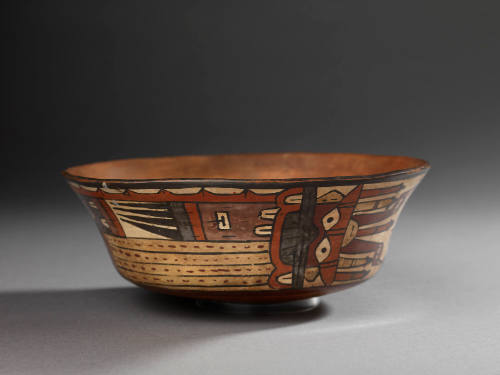
Agricultural fertility was perhaps one of the main driving
forces of Nasca culture, probably due to the arid conditions of the environment.
Most elements depicted on their ceramic iconography were animals,
anthropomorphic figures, plants, or trophy heads, all of which were intimately
associated with agriculture, the life-giving power of water, growth, and
productivity. The anthropomorphic mythical being became a prominent motif in
the midst of fertility worship, as it likely represented a god-like protector
of crops. This motif morphs animalistic elements into highly stylized,
symbolic, and powerful spirits in nature. In some cases, the motif may be a visualisation of
shamans adorning ornaments to embody the god, which may be the
case here. A pair of feet and arms can be seen at opposite ends. A trophy head
forms the ‘wing panel’, with feathers at the tail. Raptorial birds such as the
condor and falcon were respected for their role as dominant predators of the
air and thus was seen as the manifestation of mountain gods, and were also
connected to fertility as they preyed on pests. To adorn their likeness was to
embody what they symbolise, albeit briefly – their ferocity, their protection.
The darts protruding at the face may indicate the creature is on a hunt of
sorts. This dart-bodied anthropomorphic mythical form appears in Phase 5 in the second half of the Nasca culture.


If you see an error or have additional information, please contact us.